
Originally published in the
Author's Note section of
Yokai Country™ (Part One).
お疲れ様でした! You have now officially completed Part One of the Yokai Country™ saga. I have wanted to write an East-Asian fantasy series for a very long time. But before there was Temujin, Kuromaru, or even the many lands of Wakuni, there was only a boy and a dream. Those who are already familiar with my other written works will definitely know of my life-long pursuit of Japan and of the manga dream. But if this particular book is your first from Owl Shogun Studios, then here's the basic premise.
In essence, ever since I was eleven years old, I decided that my supreme goal in life was to go to Japan and become a professional manga artist. That same year, I conceived of a character who would go on to become the protagonist of my mainline series. In those early days, he was simply called Vulcan; named in reference to the ancient Roman god of fire and the forge. But given how similar it was to the Vulcans of Star Trek, his name was changed to the current Velkan.
For many years, I remained committed to the pursuit of this manga dream despite persistent environmental and situational limitations which severely slowed down my progress. But from the very start, I understood that what I sought to achieve was unorthodox in nature. Back then, and still today, there seems to be an intrinsic cultural resistance to the idea of a westerner creating manga. Many today still consider manga to be a fundamentally Japanese endeavor and that someone from the west can never hope to produce something with the same fidelity as them.
I categorically rejected this narrow-minded notion. Although, even I had to acknowledge the blatant fact that manga, as a profession, is simply not a viable career path in the United States like it is in Japan. And certainly, I had my fair share of rejections and detractors from publishers such as Funimation and Viz Media who even told me as such. I learned very early in my youth that if I was going to make this wayward dream a reality, it would require imaginative solutions and a high tolerance for naysay.
However, as I got older, life inexorably became more complicated and my time far less plentiful. The realities of the world and the cynicism it promoted began to slowly obscure my vision; like an interminable fog which hid even the brightest of flames. Just as old Sisyphus, king of Ephyra, was cursed to forever push a gargantuan boulder up a hill only for it to roll back down in perpetuity, so too did the manga dream start to feel like a Sisyphean labor.
There were various moments when I felt utterly compelled to give up; overwhelmed by the moral decay of low-wage jobs whose only purpose was seemingly to extract every ounce of value from me until I was left rotten, withered and pillaged of all that made me hopeful in the milieu of corporate America. There were even periods throughout my twenties where I nearly surrendered to my lowest instincts; tempted by the sweet mercy that suicide promised. But every time I sank into such abysmal depths, I would be reminded of that young boy who dreamed a dream. In those instances of stygian misery, it was always the Manga Dream which effectively pulled me back into the warm light of endless possibilities. Always, that boyhood dream would rekindle the flame within and beckon me to press onward.
However, manga creation is truly an all-encompassing labor which demands immense time and dedication. This, in and of itself, is no obstacle to me as I love manga more than anything in the world. Yet the iniquitous burdens of adult life no longer afford me the time or resources to invest into so costly an endeavor. I knew that at this rate, I would never achieve the manga dream. After more than fifteen years of numerous attempted manga projects, failing to build a social media presence, and trying to convince publishers to no avail, my faith in myself evaporated to the point where I felt like an irredeemable loser. But sometime during my late twenties, unwilling to give up on the dream, I came upon a rather interesting idea.
If, due to my circumstances, I can't produce a world-class manga of a professional quality within a timely manner congruent with modern demand, then I would have to build a team. In essence, a studio of talented artists who would help me create manga at a commercial capacity fit for a globalized, 21st century marketplace. Such a team would require a considerable amount of capital which, as of this writing, I simply do not have. So that's when I began to shift my life towards the acquisition of said capital with the sole intention of launching an official manga production studio.
But there was something about this that bothered me deeply. While I pursue monetary gain, what was to become of the fifteen-plus years' worth of notes, ideas, concepts, sketches, and prototype manga drafts that I had stashed away in my closet? What was to become of the very story I had been developing since I was eleven years old? There had to be something I could do in the meantime which could still satisfy that innate hunger for creative fulfillment. At the end of the day, we artists are required by nature to express our passions in some way or form, lest we become bereft of all that is essential to life.
The answer came in the final months of , in the midst of a global pandemic, where I flirted with the idea of taking my notes and adapting them into a series of fantasy novels. Essentially, while pursuing financial vitality, I would also become a part-time author. Never could I have realized just how monumental that decision would be for me and the future of the manga dream. On , I published my very first novel at the age of 27... Far older than I would have liked... Nonetheless, it was the culmination of many long years of persistent ideation which led to the first installment of my mainline series: Deorum Legions™.
Set in the land of Theia, Deorum is a fantasy of which its very essence is derived from the old Greco-Roman world of classic antiquity. In this mythical setting of divine gods, mighty gladiators, and eldritch beasts, we follow the life of a young legionnaire named Velkan Marius Aurelian who aims to become consul and rule over the Lucian Republic. Currently, there are four volumes published with a fifth planned for release in early .
But while the story of Deorum Legions™ serves as my primary focus, destined to be adapted into a full-fledged manga, there was another story with an entirely different concept which coexisted in my mind along with Velkan's Greco-Roman fantasy. That's where Temujin Mugen comes into the picture.
Finding Temujin
For as long as I can remember, I always preferred Epcot over the other major theme parks of the Walt Disney World Resorts. Even as a child, there was something inexplicably alluring to it that the other three parks (Magic Kingdom, Hollywood Studios, and Animal Kingdom) lacked. For a youth who yearned for life beyond the dull and culturally bereft swamp of Florida, Epcot provided a sublime escape. At the rear of the park, there's a section known simply as the World Showcase which, true to its name, features a dazzling collection of expertly detailed pavilions designed to evoke the nations of Canada, France, the United Kingdom, Mexico, Italy, Germany, the United States, Morocco, and my two personal favorites — China and Japan.
Often, I would lose myself with awe and wonder over the architectural details, smells, sounds, and ambience of each environment which sought to emulate their respective countries. In those halcyon days of yore, it was the closest thing I had to simulate the exciting life of a world traveler. As a lifelong appreciator of art and history, Epcot served as a critical window into a realm beyond the rather quotidian conservatism and banal rurality of hometown Davenport, Florida. Each time I strolled through the different pavilions, numerous ideas emerged from an internal reservoir of creativity sparked by my innate desire to see the world..
In particular, the Japanese and Chinese pavilions both provided me with the most heightened sense of adventure. Of all the places on Earth that a child could ever hope to visit, I distinctly recall gravitating mostly towards the distant lands of east Asia. Even if it was merely a well-crafted illusion built by Disney's brilliant Imagineers, it was a stimulating enough setting for my younger self to be fully immersed in the fiery aestus of eastern fantasies — allowing my imagination to flourish.
It would also be in Epcot, just over ten years ago (), that the idea of a lone wanderer riding across an ancient Asiatic landscape atop a beast, first entered my conscious thought. However, the true origins of what would become Yokai Country™ extends further into my past.
Back in the summer of 2012, there was an international manga competition organized by the Japanese Ministry of Foreign Affairs. I was only 17 years old at the time and had just graduated high school. I spent the greater part of three weeks drawing constantly with only four hours of sleep per day. Since I believed that this contest would be a means to enter Japan's manga industry, I gladly committed to such an extreme schedule in order to produce a one-shot manga worthy of recognition. I felt that if my art and writing was good enough, I might finally have a chance of achieving the ultimate dream... Sadly... Nothing ever came of it.
In truth, it was a rather pitiful work. The art was horrendous, and the story was laughably amateur. Even though I poured my heart and soul into every stroke of ink, that fifty-five-paged manuscript amounted to nothing more than an awkward mishmash of chanbara samurai films and gigantic mechas. Despite this glaring disappointment, the experience of waking up to draw from sunrise to sundown was invaluable to forging an iron-clad work ethic that would endure to this day. As for the title of that 2012 one-shot manga, I chose to bestow upon it the name of EON™.
Very few elements and concepts from the project would ever translate into future works. However, there are two specific characters that did get recycled for later use. One such character was a prototype of what would eventually become Praelior Livens, who would not reappear again until Book 2 of Deorum Legions™ which came out in . The other character was a katana-wielding wanderer clad in blue robes and a simple straw hat. This, of course, was the very first instance of what would one day become Temujin. But long before he was a banished onmyōji, he was a simple farmer from Xenorath Village named Ancel.
After that faithful summer, my time for writing and drawing significantly reduced as I entered college for a worthless bachelor's degree in video game art & computer animation. Although I would still, on occasion, develop Velkan's storyline in very rare moments of free time, I did next to nothing for Ancel. In those days, he was simply a generic and disposable character from a failed side project. Velkan had existed since the very inception of the manga dream and took precedence over everything. It wouldn't be until that the seeds of an Asian fantasy arose within me with Ancel returning to the very forefront of my mind.
That year, I had visited Epcot with a cohort of friends. I was only 20 at the time, but I fondly remember when we reached the Chinese pavilion and happened upon an unusual set of bronze figurines depicting a group of twelve or so warriors. Each of them had a unique shape as well as different armor and weapons and were all crafted with exquisite detail. For some reason, I was mesmerized by these bronze warriors. In those days, I knew next to nothing about Chinese history nor the fascinating nuances of its culture. Perhaps what I witnessed were standard motifs within the society such as the monk Budai or the famous Sun Wukong. Regardless, the fact remains that those bronze warriors left an indelible impression on me.
In the absence of such prerequisite knowledge on the intricacies of Chinese artistic tradition, all I could do was admire these figurines and ponder over their possible significance. I began to imagine a fictitious storyline about these mysterious warriors facing incredible trials and turbulations whilst overcoming a myriad of deadly foes. That same evening, I returned home and sketched out my own version of the twelve warriors; combining Chinese, Japanese, Korean, and even Indian aesthetics to create a diverse cast from various imagined lands.
That is when I remembered our old friend, Ancel, from the EON one-shot. I decided to resurrect him from the purgatory of abandoned ideas and assigned him the central role as protagonist of this ragtag group; initially referred to as the Black Lotus. Since the name Ancel did not really fit within this developing Asian setting, I quickly changed his name to the more exotic-sounding Temujin. At the time, I was reading up on the travels of Marco Polo and his journey to the heart of the Mongol Empire. I then decided to use the name Temujin, which was the given name of the warlord, Genghis Khan. The family name of Mugen is taken from the Japanese word for infinite
because... Well, I thought it sounded cool... That's all there is to it! I even changed his outfit to the current design as shown in this very book.
At around the same time, the third installment of the Witcher video game franchise had just released in . Produced by the Polish game studio, CD Projekt Red, Witcher III: Wild Hunt went on to become one of the most successful games of that year and continues to be looked on fondly by gamers even to this day. Based on the original books by renowned Polish author, Andrzej Sapkowski, The games follow the story of Geralt of Rivia who is himself a professional monster slayer.
For several months, I lost myself in this rich and vibrant world of grotesque beasts, warring armies, and genuinely captivating characters. As I played the game with utmost enthusiasm, I often ended up pretending that Geralt was instead Temujin wandering throughout the continent atop a mythical dragon instead of a generic horse. But this got me wondering: where were all the of Asian fantasy games?
In the western world there seems to be this unspoken rule that if a story is set in a fictional universe, then it must always adhere to the tired trope of medieval European aesthetics with armored knights, wizards, elves, dwarves, goblins, dragons, et cetera. To be fair, many assumptions of what makes a legitimate fantasy setting can be attributed to Tolkien's magnum opus, Lord of The Rings, which essentially created the modern fantasy genre as we know it.
Even though I sincerely love a good medieval fantasy game, book, movie, or TV show, I also feel that there is an untapped potential to expand our definition of what constitutes as proper fantasy. It's almost as if the west is unwilling to decouple from the very idea that fantasy must always equate to the European Middle Ages. It was in my yearning for something unique and different that led me to set Velkan's story in my own fantasy version of the ancient Mediterranean. This choice includes not just the culture and aesthetics of the Greeks or Romans, but also of the ancient Egyptians, Persians, Gauls, Nubians, Illyrians, Phoenicians, Akkadians, Sumerians and so on. It's an exciting setting that I feel is largely unexplored in fictional literature.
But as I continued to play the Witcher, delving deeper into its rich lore and world-building, I began to wonder why there weren't similar experiences set in non-western centric places within the video game industry. Back in , as far as I was aware, there simply wasn't a suitable equivalent. And so, taking the concept of a wandering monster hunter like Geralt, fused with my enthusiasm for Asian culture, I began to form the basis of what would one day transform into the very book you are now holding in your hand.
Samurai Country
One notable dilemma I faced when developing these novels was that, due to living in Florida, there was (and still is) very little in my immediate environment to reference or derive inspiration from in the crafting of an authentic fictional setting. To compensate for this pervasive ennui, I found myself entirely reliant on foreign entertainment media. However, none of this was truly a lived experience which could inform my work via an intimate or experiential touch.
With the creation of Deorum Legions™, I could sort of overcome this cultural desert by virtue of the fact that the United States of America is descended from a proud heritage dating back to the ancient Greco-Roman period. Absent ready access to the immaculate cities of Europe and its treasure trove of pristine archeological sites, I had only books as my primary means to fill in the gaps of my incomplete imagination. While the ancient Romans are underutilized in the video game space, there's quite a sizable collection of films and TV shows which feature the ancient world; albeit with a distinctly Hollywood lens. However, it was through literature written by passionate scholars where I found the bulk of my research material.
I read as many books as I could reasonably get my hands on — anything and everything — to unveil the mysteries of the Greco-Roman world as well as all of the nuances and intricacies which defined that period. This abundance of material informed my writing process, allowing me to craft a much more colorful and believable world which I sincerely hope captures the essence of Roman life through the filter of a fantasy story.
If you're wondering why I talk so much about Deorum when this is supposed to be about Yokai Country™, it's because their developments were essentially parallel to one another. Even though Deorum received the bulk of my attention, over the years my interests often switched back and forth between the two series like the swinging of a pendulum. This time, the pendulum happened to swing far enough in the other direction and this book was the result. But while there is a vast amount of research material (regarding ancient Rome) available across a wide range of mediums, I found that the same was not true with respect to the far east.
Frustratingly, I discovered an alarming lack of literature written in English for general Asian history when compared to Roman, Greek or even Egyptian history. It seems that much of the information I seek exists primarily in its native format with competency in Japanese or Mandarin being an expected necessity. One day, I will master these languages and assimilate the knowledge hidden in those tomes with relish. Meanwhile, what of the books I've yet to write? How was I to inform my worldbuilding to the same quality as Deorum when the culture depicted in such a story is so fundamentally different from my daily life?
While I did indeed have much exposure to Japanese popular culture such as anime and manga, I consider these to be a superficial lens. To truly understand a people, one must come to know their full history. And so, just like with Deorum, I endeavored to accumulate as much information as possible. Having been born in the west, I wanted to avoid certain pitfalls I've seen other writers make when choosing to emulate Asian culture in a story. Hollywood is rife with examples of orientalist assumptions that are often outdated, racist, and plain inconsistent with reality.
In the early stages of Temujin's story, I chose to cast him in a world loosely based on feudal Japan. However, there was yet to be any yokai or spell-conjuring wizards. The Land of Wakuni did not exist, nor did the concept of the Mikado or the capital city of Taiyō-kyō. My sketches were bare-bones and absent of many features that would later come to define the modern Yokai Country™
At this point, Temujin was merely a wandering ronin who formerly served as a samurai retainer for some fallen daimyo. He did not yet ride atop a kirin either, but rather walked on foot. It was, in my opinion, a very unremarkable story which shamelessly copied Japan's famed Sengoku Jidai (warring states period during the 16th century) but with super-powered samurai and shinobi. I envisioned Temujin being an aimless vagabond going from battlefield to battlefield slicing through armies of ashigaru foot soldiers like a Dynasty Warriors player.
Much of the later versions of this story would be inspired by several sources such as Moribito (A novel written by Nahoko Uehashi) and Shogun (A novel written by James Clavell). The video game series, Nioh (I and II, developed by Team Ninja) exposed me to a vast tapestry of mythical yokai and formally introduced me to the concept of onmyōdō, or the Way of Yin & Yang. Sekiro, a video game produced by FromSoftware who also gave us Dark Souls, Demon's Souls, Bloodborne, and Elden Ring, presented a most transcendent gaming experience. Ghost of Tsushima, set in the highly cinematic backdrop of 13th century Japan, presents a gripping tale of a lone samurai named Jin Sakai who struggles to defend Japan from a Mongol invasion. I even began watching various old and classic Japanese films from Akira Kurosawa such as Seven Samurai, Rashomon, Throne of Blood, Yojimbo, Kagemusha, and The Hidden Fortress. This is but a small fraction of the media I had consumed to inform my writing while I scrounged up what little I could on historical accounts as well as insight into Shinto, Taoism, Confucianism, and Buddhism.
But although I enjoyed reading about the harrowing struggles of samurai clans vying for dominance or of the legendary exploits of figures such as Oda Nobunaga, Toyotomi Hideyoshi, and Tokugawa Ieyasu, China's iconic Three Kingdoms period is equally fascinating to me. After the calamitous fall of the Han Dynasty, many warlords clamored against one another to control the realm. Among such people were Cao Cao, Liu Bei, Dong Zhuo, and Lu Bu.
It is in these moments of utter chaos that people rise to the occasion and whose stories are told and retold; capturing the imagination of future generations. Japan's Sengoku Jidai and China's Three Kingdoms period intrigue me in much the same way that the civil wars of the late Roman Republic do. You had towering figures such as Cicero, Crassus, Pompey, Gaius Julius Caesar, Mark Antony, Brutus, and even the Egyptian queen, Cleopatra, all competing for control of the Mediterranean until only one man remained — he who would become the princeps of an empire: Augustus.
I wanted to create an ultimate epic which synthesized elements of all three of these tumultuous periods in history similar to how George R.R. Martin's Game of Thrones derives much from the War of The Roses in which two opposing families, the houses of Lancaster and York, fought bitterly for the English throne from 1455 to 1487. However, not long after, I suddenly lost all momentum with Temujin's story. Life got busy as usual, and the pendulum swung back to Deorum. Thus, this lengthy back-and-forth dance between Temujin Mugen and Velkan Aurelian would continue throughout my twenties. Suffice to say, Temujin received very little care or meaningful development during this time; my East-Asian fantasy world trapped within a sort of self- imposed stasis. Often, I wasn't even sure if I wanted to write it anymore... But then I finally went to Japan.
In 2019, I seized an opportunity to live and work in Japan as an assistant language teacher (ALT) and served in the town of Namegata in Ibaraki prefecture. As soon as I (regrettably) returned to the United States, I began working on the manga dream with renewed vigor. When the world was besieged by the Covid-19 pandemic, I had ample time during the ensuing lockdowns to devote myself purely to Velkan and Temujin in equal measure. By this point, the concept of a Greco-Roman fantasy had already been conceived and was in the process of persistent ideation. At the same time, I was delving deeper into the limitless possibilities that a Temujin story could offer and eventually came up with the continent of Wakuni.
Not long after, several of the characters you're familiar with came into being such as Kuromaru, Monzaemon, and Izumi. Yokai, Mononoke, and Ayakashi were also starting to slowly populate the world, although their role was not yet clear. And while onmyōji were indeed present, they did not carry any sort of weight in my mind. They existed only in the periphery of this young and germinating fantasy. Temujin's story was still very much firmly rooted in the cliche tropes of samurai media.
And perhaps it is because of how pervasive and common samurai are in anything even tangentially related to Japan, that I soon lost interest again; once more pivoting to the more unique Deorum. The trigger which prompted me to commit fully to Temujin came in the form of a near-catastrophic car accident in .
The Way of Yin & Yang
Long story short, I got into a terrifying car accident when a wayward driver, who neglected to adhere to both signage and speed limits, slammed into my side; effectively causing my vehicle to flip over twice. Luckily, I came out relatively unscathed. But this harrowing experience left me with a renewed resolve to fulfill the manga dream. During my recovery, I spent every waking moment trying to finish Book 4 of Deorum Legions. Once that was completed, I set my gaze towards Temujin Mugen.
The desire to make my very own Asian fantasy still burned brightly, but I feared that my enthusiasm would waver over time like it always did. I concluded that the reason was due to it being about samurai. As of this writing, there is already an overwhelming abundance of samurai content across various forms of media from anime to video games. They are to the Japanese what medieval knights are to the west. But just as there is more to western history than the Middle Ages, there is so much more to Japanese history than the Sengoku Jidai or the Edo period which every piece of media seems to center around with obsessive fixation.
The idea of making yet another story adhering to the rather unimaginative trope of samurai just did not appeal to me. Thus, I decided that Temujin's story would have nothing to do with samurai whatsoever. I would center it around yokai and other intriguing entities prevalent in the mythos of Shinto and Buddhist tradition. But I needed to equip Temujin with the means to combat against yokai such as oni, kappa, and tengu. That's when I remembered those obscure wizards of the imperial court. Of course, I'm referring to our beloved onmyōji.
In Deorum, the primary fighting force in the series are the legions of Lucium. Their bodies are infused with the Elysium Crystals and have been bestowed incredible power from the goddess, Romula. But their fighting techniques are rather straightforward and streamlined. As of right now, there are no equivalents to magicians in the world of Theia. Onmyōji, however, offer me the exciting opportunity to explore an entire class of warriors whose entire framework revolves around ancient Taoist sorcery.
The more I researched the onmyōji, the more the world of Wakuni solidified in my mind. Before I knew it, the story had greatly shifted to resemble Heian period Japan with some trace elements of Han and Tang dynasty China. The Heian period is often considered the classical era of Japanese history and is the time when Japanese culture truly began to flourish — branching away from the heavy influence of mainland China such as in prior centuries. That's when I learned that in the capital city of Heian-kyō (modern-day Kyoto) there was once a branch of the government known as the Onmyōryō, or the Yin-Yang-Bureau.
From there, everything started to fall into place. Ideas kept emerging from the fountainhead of my consciousness with incredible consistency. No more was Temujin merely a wandering ronin, but a master of the ways of yin and yang, the five phases, and a host of other arcane techniques contemporary to the myths of ancient Japan. But when I imagine the city of Taiyō-kyō, I envision the ancient Tang Chinese capital of Chang'an — a city that was every bit as grand and immaculate as Byzantium's Constantinople.
In the first drafts of this book, I wrote Temujin as a working sorcerer actively serving the bureau in the name of the Mikado, the emperor. But in such a setting, I was unable to focus on yokai like I originally wanted to. I rewrote it several times to better match the feelings of wonderment I felt when playing The Witcher back in . At the end of the day, Temujin was initially conceived as a slayer of monsters. And thus, I wrote the current version of this book where he is a disgraced onmyōji banished from the capital and forced to traverse the land endlessly where his only practical means to make a living is to take on contracts and hunt yokai.
Lastly, I decided that, rather than tell a traditional or linear story in adherence to the old Aristotelian three-act structure, I would instead tell a total of five separate tales featuring Temujin, formerly Ietsugu, during his thirty-year period of banishment. This is a nod to the more episodic storytelling implemented in shows like Samurai Champloo and Avatar: The Last Airbender. At long last, I got the East- Asian fantasy I always wanted — albeit a simple one.
In the next installment (Part 2), I hope to delve much deeper into the Lands of Wakuni, the capital, and the very nature of the Yin-Yang Bureau. This first book was meant only to introduce readers to the world of Yokai Country. I have a plethora of ideas that I can't wait to share with you, and I assure you that the tales of Temujin are far from over! There's still much more to come for characters like Hayate, Monzaemon, Izumi, Li Qian, and the great Lord Sōgen.
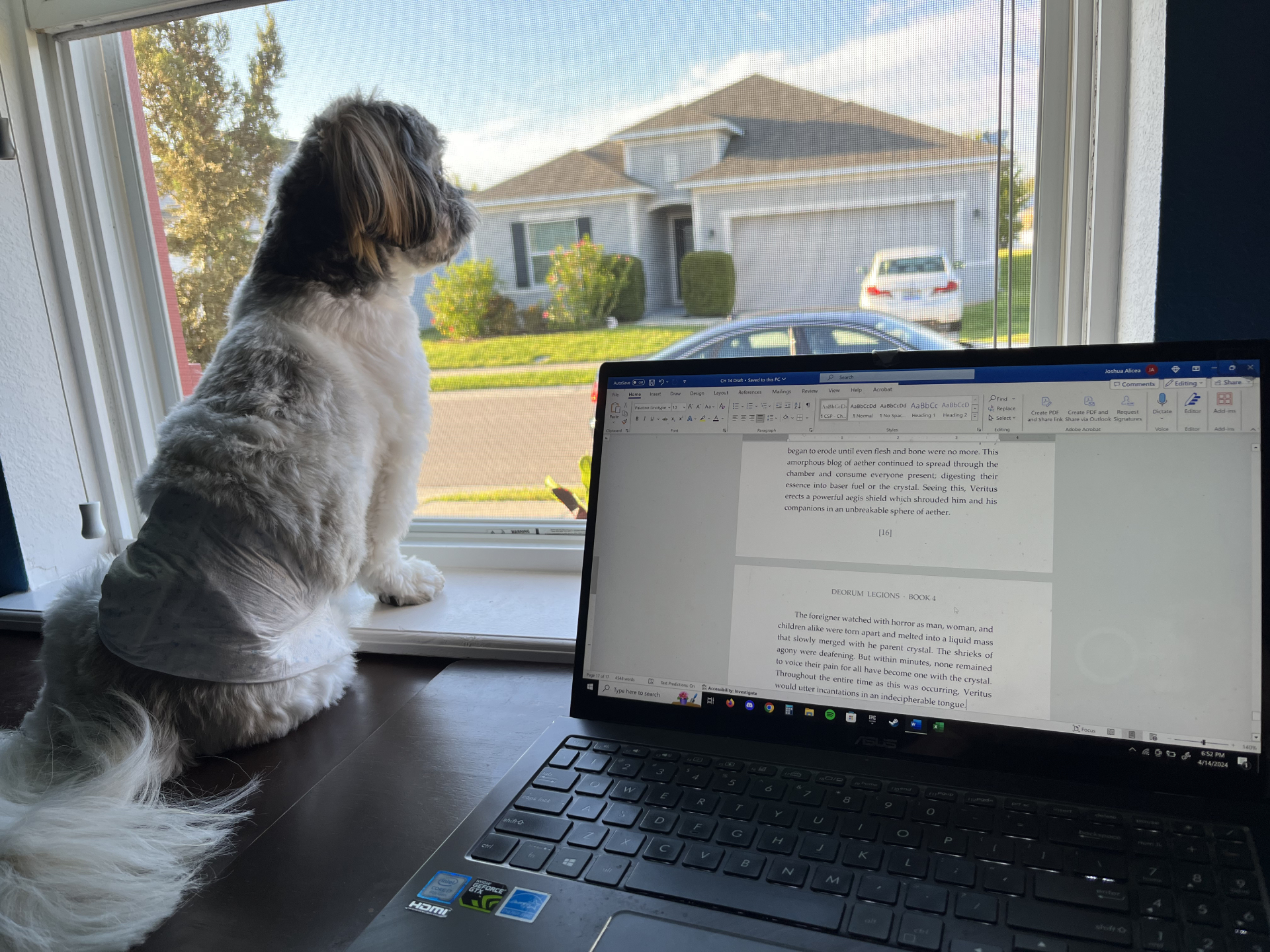
Speaking of Sōgen, the idea for an all-powerful yokai based on a humanoid Shih Tzu was directly inspired by my very own dog. His name is Yoshi, the cutest darn thing I've ever seen. Ever since he came into my life, he's been my steadfast companion and is always by my side when I write.

Sometimes I convey to him my ideas despite his lack of verbal feedback (lol). It helps me to overcome writer's block. All the same, I always feel his intense love and support which inundates me with an unyielding wave of resolve. Thank you so much, Yoshi! You are now, forevermore, immortalized in these pages as Lord Sōgen.
There is so much more I can talk about regarding the making of Yokai Country, the research that went behind it, and the path I'm taking to achieve the manga dream. But all of that can be a book in its own right and we simply haven't the time nor the space for such indulgent musings of the ego. Therefore, I shall end things here for now.
Already, I am working on Part Two of Yokai Country and have many fun things planned. In the meantime, I have taken the liberty of adding the first chapter from Book 1 of Deorum Legions™ at the end of this lengthy Author's Note section so that you can preview it for yourself. Who knows? Perhaps Deorum Legions™ can provide you with a suitable placeholder; at least until the next installment of Temujin's story is released sometime in the near future. I hope you'll join me on this grand journey into the lands of Wakuni. Thanks for reading... お元気でいてください。
The Owl Shogun ( Age 30 )
Davenport, Florida, USA
November 21, 2024